






















AI Agents for Business: What's Actually Working in 2026
Introduction
By the end of 2026, roughly 40% of enterprise applications are expected to include a task-specific AI agent, up from under 5% just a year earlier. That's one of the sharpest adoption curves seen in enterprise software since cloud computing took off in the early 2010s. And yet, ask ten business leaders what "AI agent" actually means in practice, and you'll get ten different answers — some picturing a smarter chatbot, others picturing something closer to a digital employee that plans, acts, and adapts on its own.
Both pictures are partly right, which is exactly why this space is confusing to buy into right now. This article cuts through the noise: what an AI agent actually is, where they're genuinely earning their keep in 2026, and — just as importantly — why so many agent projects that looked great in a demo never make it to a stable production environment.
What Actually Counts as an "AI Agent" in 2026
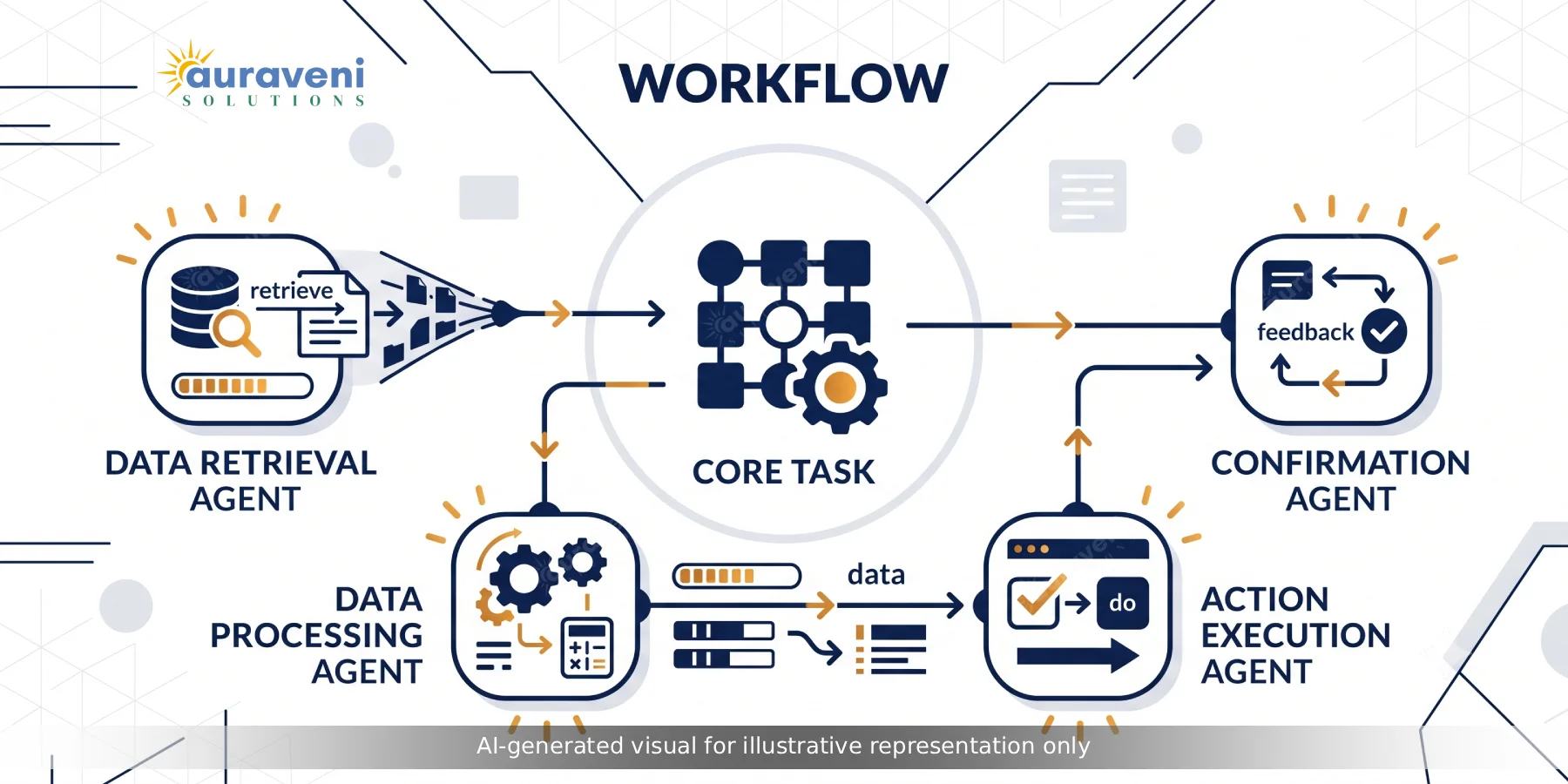
The term gets used loosely enough to cover everything from a slightly-smarter chatbot to a fully autonomous system managing an entire workflow unsupervised. The useful distinction isn't marketing language, it's behaviour: a chatbot responds to a single prompt and stops. An agent can plan a sequence of steps, call tools or APIs to gather information or take action, hold that context across multiple steps, and adjust its approach based on what it finds along the way — closer to a junior team member working through a task than a search box answering a question.
That distinction matters practically because it changes what you're actually buying or building. A well-built agent for, say, customer support doesn't just answer a question — it can look up an order, check a refund policy, process the refund, and send a confirmation, chaining several actions together toward one outcome, with a human able to step in at any point that requires judgment the system doesn't have.
The Adoption Numbers, Read Honestly
The headline statistics are genuinely striking. Roughly 79% of companies report AI agents are already being adopted somewhere in the organisation, and 88% of executives say they plan to increase AI budgets specifically because of agentic initiatives. McKinsey estimates agents could add somewhere between $2.6 and $4.4 trillion in value annually across business functions once adoption matures.
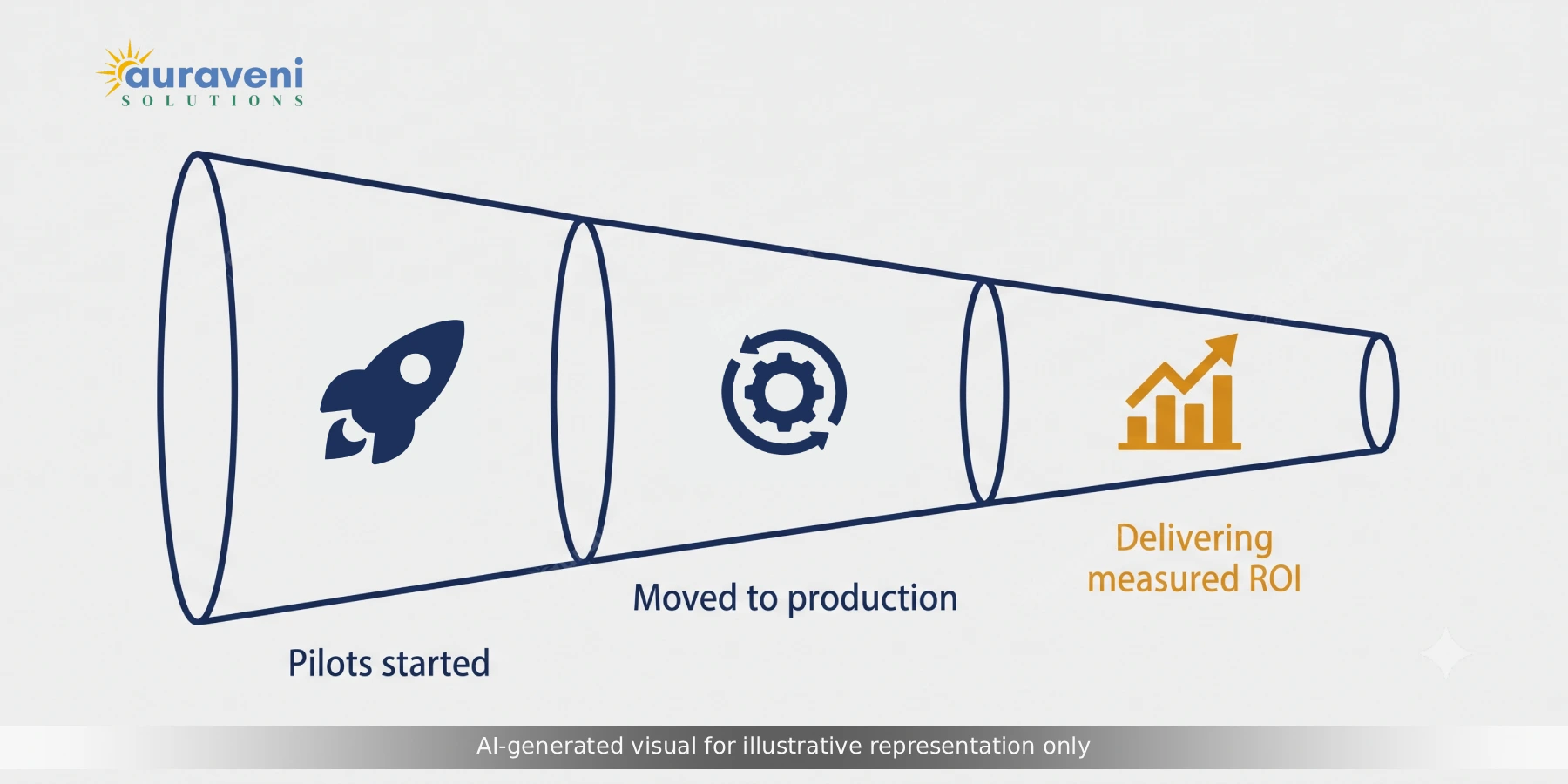
But there's a second number that matters just as much, and it rarely makes the headline: McKinsey also reports that while 62% of organisations are experimenting with agents, fewer than 25% have actually scaled one to production. A separate industry analysis puts it even more starkly — 80% of enterprise applications shipped in early 2026 embedded at least one AI agent, yet only 31% of organisations had an agent actually running in production at meaningful scale. Gartner's own warning is blunt: by the end of 2027, more than 40% of agentic AI projects are expected to be shelved, cancelled, or quietly abandoned, largely due to unclear ROI, governance gaps, and immature tooling — a pattern some analysts have started calling "agent-washing," where the label gets applied more liberally than the actual capability.
Regionally, adoption isn't uniform either. North America leads on enterprise-scale budgets and vendor maturity. European adoption moves more cautiously, prioritising auditability and compliance under GDPR and emerging AI regulation. India, Singapore, and Japan, notably, are driving some of the fastest real-world experimentation specifically in eCommerce and customer support — largely because the cost-efficiency case is so immediate and the workflows are relatively bounded, which makes them easier to get right the first time.
The honest read: this isn't hype without substance, but it also isn't as uniformly "solved" as vendor marketing suggests. The gap between "we're experimenting with agents" and "we have an agent doing real, unsupervised work reliably" is exactly where most of the actual risk and actual opportunity both live.
Where AI Agents Are Delivering Real ROI Right Now
A handful of use cases consistently separate themselves from the pilots-that-never-shipped pile:
- Customer service, by a wide margin. High ticket volumes, relatively predictable intents, and clear, measurable KPIs make support the fastest and most reliable path to demonstrated agent ROI — autonomous ticket resolution, refund processing, and routing to the right specialist without a human triaging every single request first.
- Sales operations and lead qualification. Agents that can research a lead, check it against CRM history, and draft a genuinely personalised first outreach — rather than a templated blast — are showing up consistently in sales-tech adoption data as one of the higher-confidence use cases.
- Finance and operations tasks with clear rules. Invoice matching, expense categorisation, and anomaly flagging in transaction data are bounded enough tasks that an agent can be trusted with them relatively early, with a human reviewing exceptions rather than every transaction.
- Supply chain and inventory monitoring. Agents that continuously watch stock levels, supplier lead times, and demand signals, then flag or initiate reorder actions, are proving valuable specifically because the alternative — a person checking dashboards periodically — misses things that happen between check-ins.
The common thread across all four: the task is bounded, the success criteria are measurable, and a human remains genuinely available to catch the exceptions. Agents deployed into vague, open-ended, high-stakes decisions without that structure are exactly the ones showing up in Gartner's "cancelled by 2027" projection.
Why Most Agent Projects Stall Before Production
The reasons an agent pilot fails to reach production rarely have much to do with the underlying AI model's capability. They tend to cluster around three things.
- Unclear ownership after the pilot succeeds. A prototype agent works beautifully in a demo, everyone's impressed, and then it sits there because nobody has the mandate, budget, or operational responsibility to take it from "impressive demo" to "monitored, supported production system."
- Data and integration debt. An agent that needs to check inventory, look up customer history, and process a payment is only as good as its access to those systems — and stitching an agent into a business's actual CRM, ERP, and payment infrastructure is unglamorous integration work that gets underestimated at the pilot stage, then discovered the hard way during rollout.
- Immature deployment tooling. Open-source and low-code agent frameworks have made it genuinely easy to get a working prototype running fast, which is exactly why so many teams get one working quickly and then discover that "working in a demo" and "production-ready, monitored, and safe to leave running unattended" are two very different engineering problems requiring a different skill set entirely.
Governance: The Difference Between an Agent and a Liability
This is the part vendor pitches tend to gloss over, and it's the part that actually determines whether an agent deployment is safe to trust. Human-in-the-loop oversight remains the standard, expected practice in 2026 — agents are augmenting decision-making, not replacing it, and any deployment pitched as fully autonomous with no human checkpoint should be treated with real skepticism.
A properly governed agent deployment has a few non-negotiable elements: clearly scoped permissions (an agent handling refunds shouldn't also have the ability to modify pricing), a full audit trail of every action taken and every piece of context it used to take that action, defined escalation paths for anything outside its bounded task, and a rollback mechanism if something goes wrong. Getting this right from the start is considerably cheaper than retrofitting it after an agent has already taken an action nobody can fully explain — which is precisely the scenario that turns a productivity story into a compliance incident.
Build, Buy, or Assemble: Choosing Your Approach
Very few businesses need to build agent infrastructure entirely from scratch in 2026, and that's genuinely good news for cost and timeline. Most practical deployments fall into one of three paths: off-the-shelf agent products built for a specific function (a support agent product, a sales-research agent), which are fastest to deploy but least flexible to your specific workflow; low-code agent platforms, which let a business assemble an agent from pre-built components and connect it to existing tools without deep AI engineering expertise, trading some customisation for speed; and custom agent development, built around your specific systems, data, and workflow rules, which takes longer but avoids forcing your process to bend around a generic product's assumptions.
The right call depends heavily on how standard or unusual your workflow actually is — a support agent handling common, well-documented queries is a strong candidate for an off-the-shelf or low-code approach; an agent that needs to reason through a genuinely unusual internal process is a much stronger case for custom development.
What a Production-Ready Agent Deployment Actually Requires
Beyond the model itself, a production-grade agent needs: reliable access to the specific systems it acts on (via properly authenticated APIs, not brittle workarounds), monitoring that flags when the agent's behaviour drifts from expected patterns, a clear scope boundary so the agent can recognise and escalate what it isn't equipped to handle, and ongoing evaluation against real outcomes, not just the demo scenario it was originally tested against. This is, in practice, the same discipline that separates any reliable production software system from a fragile prototype — agents don't get a pass on standard engineering rigour just because the underlying technology is new.
How Auraveni Approaches AI Agent Development
We scope agent projects around one clearly bounded workflow with a measurable success metric before any development starts — not an open-ended "let's see what AI can do" exploration. From there, we build with production infrastructure in mind from day one: proper API integration into your existing systems (an area we go deeper on in our guide to API integration strategy for growing businesses), audit logging, and clearly defined escalation paths, so what launches as a pilot is already built to survive contact with real operational load rather than needing to be rebuilt to get there.
If you're weighing agent development against a broader AI roadmap for your business, our companion piece on AI and ML features actually worth adding to your business app is a useful starting point for figuring out where agents fit relative to your other priorities.
Conclusion
AI agents in 2026 have crossed a real threshold — this isn't speculative technology anymore, and the businesses using them well are seeing measurable gains in support, sales, finance, and operations. But the gap between a working pilot and a production system that's genuinely safe to trust with real customer data and real money is wider than most vendor pitches let on, and it's exactly where Gartner expects a large share of current projects to quietly fail over the next year. The businesses pulling ahead aren't necessarily using flashier models — they're the ones treating agent deployment with the same engineering discipline, governance, and integration rigour as any other production system, from the very first pilot.
If you're evaluating where an agent could genuinely move a metric in your business — rather than just sound impressive in a meeting — we're glad to help you scope that honestly before any development begins.
FAQs
A chatbot responds to a single prompt and stops there. An AI agent can plan a sequence of steps, call external tools or APIs to gather information or take action, hold context across multiple steps, and adjust its approach based on what it finds — closer to a team member completing a task than a search box answering a question.
