





















AI and ML Features Actually Worth Adding to Your Business App in 2026 (And Which Ones Aren't)

Introduction
Somewhere in the last two years, "should we add AI to our app" stopped being a forward-thinking question and became almost a default agenda item in product planning meetings. That shift is, on balance, a good thing — there are genuinely valuable AI features that didn't exist as practically buildable two years ago. But it's also produced a fair amount of noise: AI chatbot widgets bolted onto websites for the sake of having one, "AI-powered" labels slapped on features that are really just a basic filter with better marketing copy.
We get asked to "add AI" to client projects regularly enough that we've developed a fairly firm point of view on which features are worth the engineering investment and which ones are mostly theatre. This article is that point of view, stated plainly, because we'd rather lose a feature request than build something that doesn't move a single business metric for you.
Why "Add AI" Isn't a Feature Request
The honest first conversation we have with most clients asking for "AI features" is that AI integration is an architectural decision, not a plugin you bolt onto a finished product. It involves embedding intelligence into the tools your team and customers already use — your CRM, your dashboards, your customer-facing app — rather than adding a separate, disconnected "AI corner" to the product that nobody actually uses after the first week of novelty wears off.
The businesses getting real value from AI in 2026 aren't necessarily the ones using the most AI tools. The advantage tends to come from combining AI capability with something the business already has uniquely — proprietary customer data, deep domain expertise, an established operational process — rather than from the AI model itself, which any competitor can access through the same APIs you can.
The AI Features With Genuine, Measurable ROI
Based on what we've actually seen move metrics across client projects and industry benchmarks, here's where AI investment consistently pays for itself:
- Recommendation engines for eCommerce and content platforms. This is one of the oldest applied-AI use cases for good reason — it works, and the uplift is measurable. Personalised product or content recommendations based on browsing and purchase history reliably move conversion and average order value, and for a mid-size storefront, even a modest percentage uplift compounds into meaningful annual revenue.
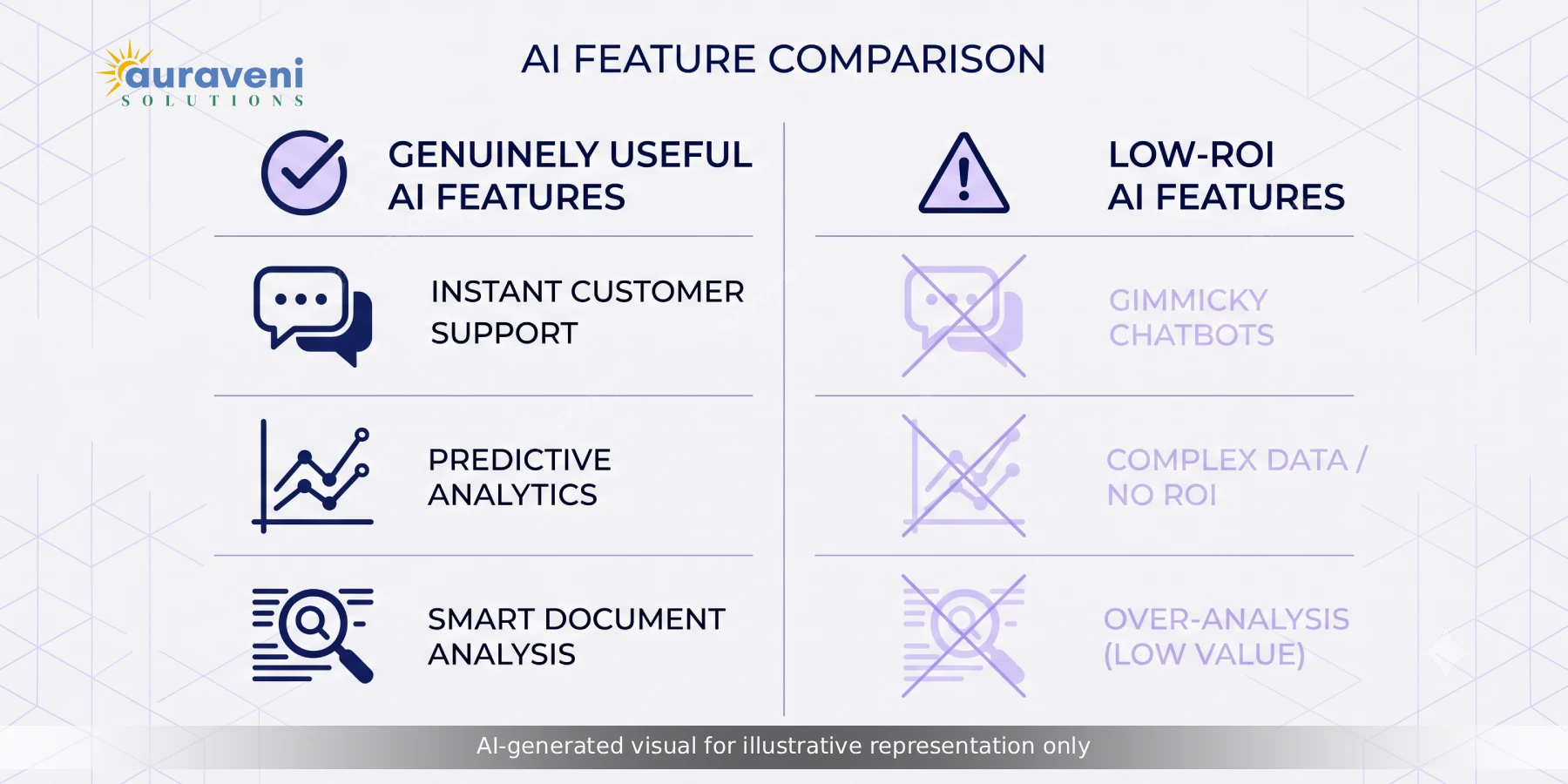
- Customer support chatbots with proper scope. A well-built support chatbot, trained on your actual knowledge base and scoped to handle routine, repetitive queries, can resolve a substantial share of incoming support volume without human intervention — freeing your support team to focus on the complex cases that actually need a human. The keyword there is "proper scope." A chatbot trying to handle everything, including edge cases it has no business attempting, erodes customer trust faster than no chatbot at all.
- Predictive analytics for demand and churn. For eCommerce and SaaS businesses specifically, machine learning models that forecast demand (helping avoid both stockouts and overstock) or flag at-risk customers before they churn are consistently among the highest-ROI AI investments available, because they convert data you already have into decisions you were previously making on instinct.
- Lead scoring and sales prioritisation inside CRM workflows. For B2B-focused businesses, AI-assisted lead scoring — surfacing which leads are statistically more likely to convert based on behaviour patterns — lets sales teams spend their limited time where it actually matters, rather than working leads in arrival order.
- Anomaly detection for operations. Less customer-facing, more operationally valuable than people expect: AI-driven anomaly detection monitoring transaction patterns, system performance, or inventory levels can flag a problem — a fraud pattern, a performance regression, an unusual stock movement — well before a human would have noticed it manually.
The AI Features We'd Push Back On (Respectfully)
A few patterns we routinely talk clients out of, or at least significantly scope down:
- A chatbot with no defined boundary. "Just let it answer anything" sounds flexible and ends up either hallucinating answers about things it shouldn't speak to (pricing exceptions, legal commitments, medical or financial advice depending on your industry) or feeling generic and unhelpful because it's trying to be everything at once. A scoped, well-trained assistant beats an unscoped, "smart-sounding" one every time.
- Generative AI features added purely for the marketing checkbox. "AI-generated reports" or "AI-written descriptions" sound impressive in a pitch deck, but if the underlying data feeding them isn't clean or the output still needs heavy human review before it's usable, you've added engineering complexity without actually removing human effort — which was presumably the point.
- Predictive features built on data you don't actually have enough of yet. Predictive analytics needs a meaningful volume of historical, reasonably clean data to produce predictions worth trusting. A six-month-old startup asking for churn prediction models is often better served spending that engineering budget on basic analytics dashboards first, and revisiting predictive modelling once there's enough data history for it to mean something.
- AI features that exist because a competitor has one. This is the single most common reason we see for a feature request that, on closer inspection, doesn't map to any specific business outcome the client can name. If you can't articulate which metric an AI feature is meant to move, it's worth pausing before building it — regardless of whether your competitor has something that looks similar.
Build, Buy, or API: Choosing Your AI Implementation Path
Almost no business in 2026 needs to train a foundation model from scratch, and that's genuinely good news for cost and timeline. The realistic decision is usually between three paths:
- API-based integration (calling an existing large language model or specialised AI API for chat, content generation, or classification tasks) is the right starting point for most business applications. It's fast to implement, doesn't require in-house machine learning expertise to maintain, and scales with usage-based pricing rather than upfront infrastructure investment.
- Managed ML platforms (like AWS SageMaker or similar cloud-native ML tooling) make sense when you need a custom-trained model on your own proprietary data — a recommendation engine trained specifically on your catalogue and customer behaviour, for instance — but don't want to manage the underlying training infrastructure yourself.
- Fully custom model development is rarely the right starting point for a business application, and we say this as a development agency that absolutely could build it if you wanted us to. It's appropriate when you have a genuinely unique dataset, a well-defined problem that off-the-shelf models don't solve well, and the budget and timeline to support an iterative training process. For the vast majority of business AI features — chat, recommendations, predictive scoring — API-based integration on top of existing models gets you to value faster and cheaper.
Data Readiness: The Conversation Nobody Wants to Have First
The least exciting part of any AI feature project is usually the most important: is your underlying data actually clean, structured, and complete enough to feed the feature you want? A recommendation engine trained on inconsistent product categorisation will recommend nonsense. A churn prediction model trained on six months of patchy customer interaction data won't be reliable regardless of how good the underlying model is.
We typically run a short data readiness assessment before scoping any AI feature seriously — not as a billable delay tactic, but because building a sophisticated AI feature on top of an unready data foundation is the single most common reason AI projects underdeliver against expectations. It's almost always cheaper to fix the data pipeline first than to discover the problem after the feature is built and underperforming.
AI Governance and Privacy: What 2026 Actually Requires
A few things worth building into any AI feature plan from the start rather than retrofitting:
- Data privacy clarity with whichever AI provider you use. Know explicitly whether your chosen API provider trains its models on the data you send it, or keeps it private and isolated to your usage — this matters considerably more if you're processing customer or business-sensitive data through the feature.
- Regulatory awareness for your specific markets. If you're serving EU or UK customers, AI governance expectations are tightening, and businesses handling customer data through AI features should expect closer scrutiny of how that data is used and disclosed. For India-based businesses, this sits alongside DPDP Act obligations around consent and data processing more broadly.
- Human oversight on anything customer-facing or decision-influencing. AI-assisted lead scoring or churn prediction should inform human decisions, not replace them outright — particularly in regulated industries like healthcare or finance, where an unexplainable AI decision can become a genuine compliance liability rather than just a product quality issue.
How Auraveni Approaches AI Feature Integration
We approach AI feature requests the way we'd want a partner to approach ours: by asking which business metric the feature is meant to move before we touch architecture. Across the platforms we've built and scoped — eCommerce recommendation logic, CRM-integrated lead intelligence, and AI-assisted customer support workflows — our process starts with a data readiness review, then a clear build-versus-API decision, before any model integration work begins.
If you're earlier in your product roadmap and trying to figure out where AI fits among your broader technical priorities, our guide on what to look for in a software development partner is a useful starting point before narrowing into AI-specific scoping.
Conclusion
The AI features genuinely worth building in 2026 are the ones tied to a specific, measurable business outcome — recommendation engines that lift conversion, chatbots that actually reduce support load within a defined scope, predictive models built on data that's actually ready for them. The ones worth skipping, or at least significantly scoping down, are the ones that exist mainly because the word "AI" sounds good in a pitch deck or a competitor's feature list. If you're planning your next AI feature, start with the metric you're trying to move, and let that decide the architecture — not the other way around.
If you want an honest second opinion on whether a specific AI feature is worth building for your product right now, we're glad to have that conversation before any engineering time gets spent.
