






















API Integration Strategy for Growing Businesses: Payment Gateways, CRMs, and the Mistakes That Cost the Most
Introduction
"Can you just integrate it with Stripe / our CRM / the shipping API?" is one of the most common sentences we hear from clients, and it's usually said with the casual confidence of someone who's never had a webhook silently fail at 2 a.m. and quietly cost a business three days of unrecorded orders.
API integration has a reputation for being simple because the marketing for most APIs makes it look simple. "Five lines of code and you're live" is true for the demo. It is rarely true for a production system handling real customers, real money, and real failure modes — third-party outages, rate limits, schema changes pushed without warning, and the particular chaos of a webhook arriving twice because a provider's retry logic doesn't know your server already processed it the first time.
This article isn't a basic "what is an API" explainer. It's the integration strategy conversation we actually have with clients before we write a single line of integration code — the failure modes, the architectural decisions, and the mistakes that are cheap to avoid early and expensive to fix once you're live.
What "API Integration" Actually Covers
At a technical level, an API integration is the mechanism by which your application borrows someone else's already-built capability instead of building it from scratch. Payment processing, mapping, SMS delivery, CRM syncing, AI model access — all of it is, increasingly, available as authenticated HTTP calls rather than infrastructure you'd otherwise need years to build internally.
But "integration" as a strategic decision is bigger than the API call itself. It's a lifecycle: discovery (what does this provider's API actually support, and where are its limits), authentication architecture, error taxonomy (what kinds of failure can occur, and how should each be handled differently), resilience design, testing, and ongoing maintenance as the third-party service itself changes over time. Teams that treat integration as "call the endpoint, done" are the ones who get paged when that endpoint's behaviour shifts without warning.
REST, Webhooks, and When You Need Each
Most business integrations use REST APIs, and for good reason — the request-response model maps cleanly onto most business operations: ask for something, get an answer back. Initiate a payment, confirm it, handle the outcome. It's the right starting point for the overwhelming majority of integrations.
Webhooks solve a different problem: when you need to know about something that happens on someone else's system, without sitting there asking repeatedly. A webhook is, technically, just an HTTP request the provider sends to an endpoint you've registered, the moment a defined event occurs on their side — a payment clearing, a shipment status changing, a subscription renewing. Polling for that information every few seconds instead would be wasteful, slower, and in some cases simply unavailable as an option.
The practical rule: build your core data flows on REST, and treat webhooks as the mechanism for anything asynchronous or event-driven, particularly anything involving payment status, since that's rarely instant from the gateway's side regardless of how fast your frontend feels.
The Five Mistakes That Show Up Most in Production
We see the same handful of integration mistakes across nearly every client project that's had a prior integration attempt before coming to us. In rough order of frequency:
- Treating the happy path as the whole path Systems get built to handle "payment succeeded," and quietly fail to handle "payment failed," "payment pending," or "subscription renewal declined." At scale, this becomes invisible revenue leakage — users staying on paid access after a card decline, simply because nobody built the failure-state logic.
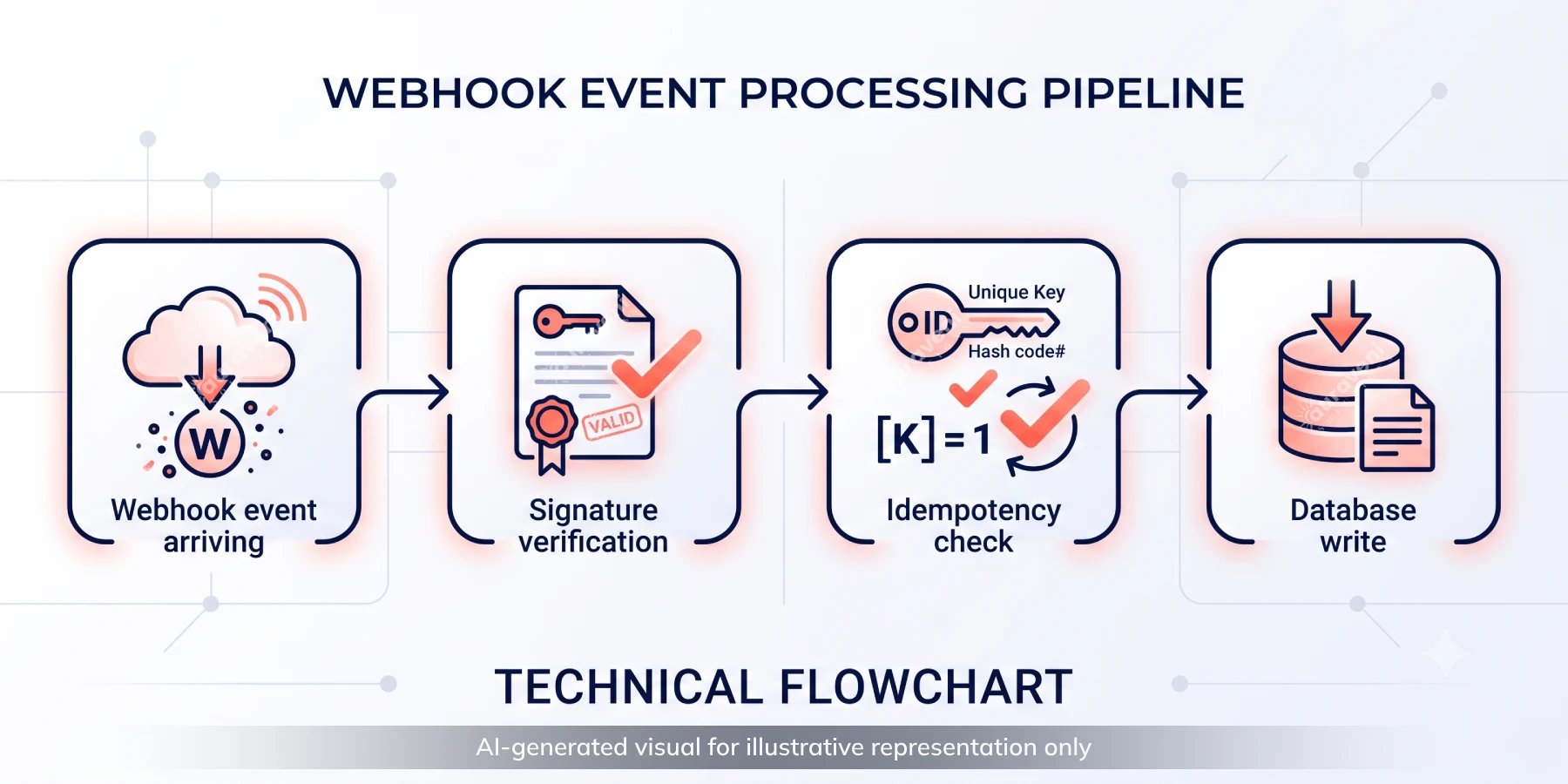
- Non-idempotent webhook handlers Providers retry webhook delivery when they don't receive a fast acknowledgment — and the same event can genuinely arrive twice within the same minute due to infrastructure quirks on their end, not yours. Without a check for "have I already processed this exact event," a duplicate delivery means duplicate processing: double-counted orders, double-sent confirmation emails, sometimes double-charged customers.
- Storing the order after calling the gateway instead of before If your payment gateway call times out after you've created the charge but before you've saved the order on your side, you have a customer who paid and a system with no record of why. Creating the order record first, then calling the gateway, means even a worst-case timeout leaves you with something to reconcile against.
- Hardcoded credentials, anywhere API keys committed to version control, even briefly and even in a private repo, should be treated as compromised the moment that happens — not "probably fine since nobody saw it." Secrets belong in a proper secrets manager, full stop.
- No reconciliation process Your database and the third-party provider's dashboard will, eventually, drift out of sync — a webhook gets missed, a network blip drops an acknowledgment. Systems without a periodic reconciliation job to catch and correct this drift tend to discover the problem only when a customer complains, which is the worst possible way to find out.
Designing for Failure: Circuit Breakers, Retries, and Idempotency
The single biggest mindset shift between a demo integration and a production-grade one is this: treat every external dependency as inherently unreliable, because eventually, it will be.
A circuit breaker pattern is the standard defence here — if a third-party endpoint's error rate or latency crosses a threshold over a short rolling window, the breaker "trips" and your system stops hammering a struggling service, falling back gracefully instead of cascading that failure into your own application's stability.
Idempotency keys solve the duplicate-processing problem at the source. By attaching a unique key to each meaningful operation (a UUID generated client-side, typically) and having your system check "have I seen this key before" before processing, retries — whether from network blips, gateway timeouts, or webhook redelivery — become safe rather than dangerous.
Versioning discipline matters more than most teams initially budget for. Never integrate against a provider's "latest" version tag; pin to a specific version, and when a provider announces a breaking change, give yourself a real migration window rather than scrambling the week it goes live.
Payment Gateway Integration: A Special Case Worth Its Own Section
Payment integration deserves specific attention because it combines every general integration risk with real financial and compliance stakes. A few specifics worth knowing before you scope a payment integration project:
PCI DSS scope is a real design constraint, not a checkbox. The integration approach you choose — hosted checkout, embedded iframe fields, or direct API integration — directly determines how much PCI compliance burden lands on your servers. Hosted checkout and iframe-based fields keep raw card data off your infrastructure entirely, which dramatically reduces your compliance scope. Direct API integration, where your own servers touch raw card data, carries the heaviest compliance requirement (SAQ D) and should only be chosen when you have a specific, justified reason to want that level of control.
Webhook signature verification is non-negotiable. Every credible payment gateway signs its webhook payloads (commonly using HMAC-SHA256), specifically so you can verify a webhook genuinely came from them and wasn't spoofed by an attacker who simply POSTed to your public endpoint. Skipping signature verification is one of the more dangerous shortcuts we see in inherited codebases.
Test every failure scenario in sandbox, not just the success path. Successful payment, declined card, insufficient funds, expired card, duplicate webhook delivery, session expiry, subscription renewal failure — a payment integration that's only been tested against the happy path will find every one of these scenarios in production, usually on a weekend.
Building an Integration Strategy, Not Just a Connection
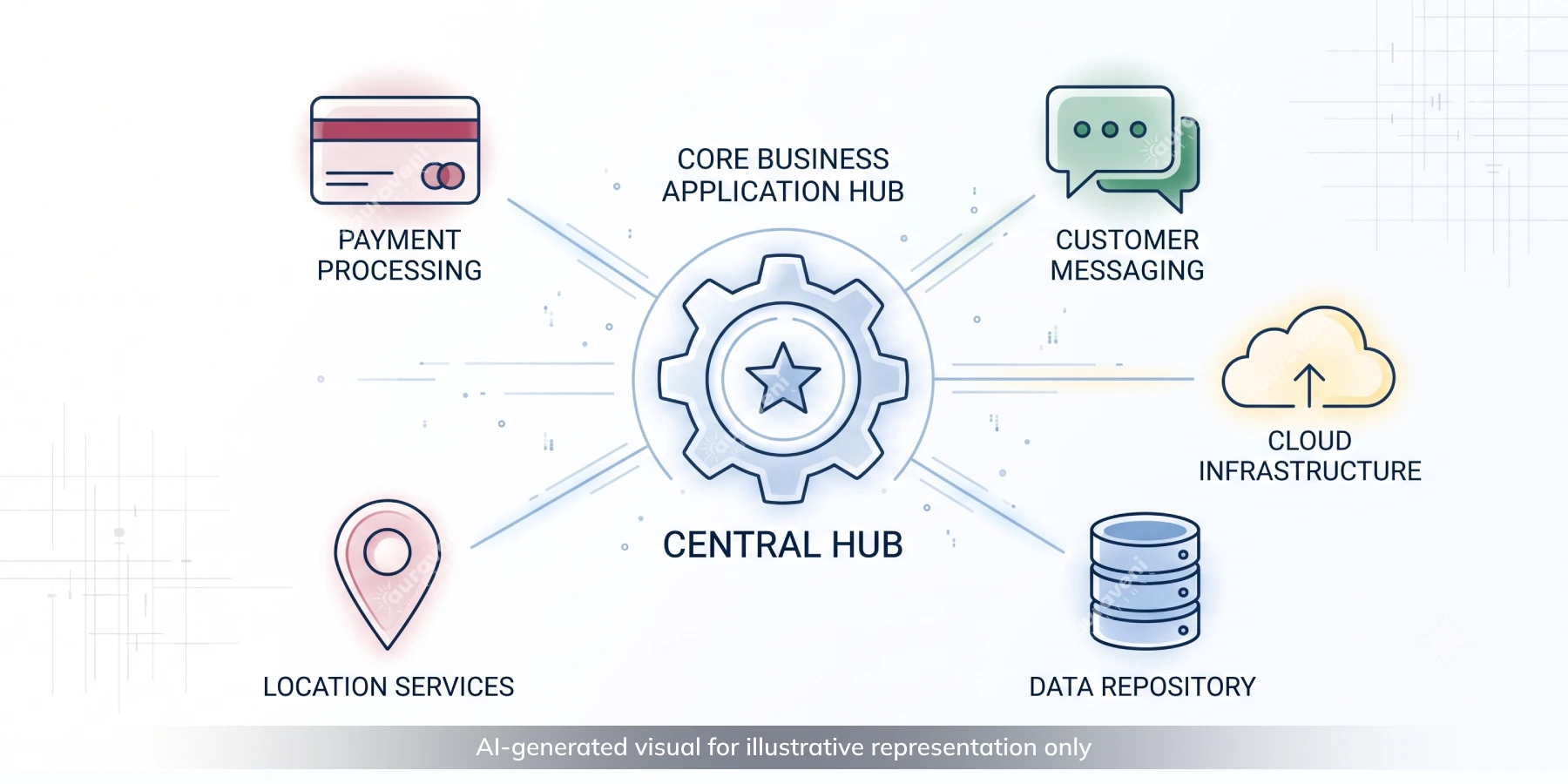
A genuine integration strategy, rather than a one-off connection, typically involves routing requests through an API gateway or middleware layer that centralises authentication, rate limiting, logging, and retry logic before a call ever leaves your infrastructure — rather than scattering raw third-party calls throughout your codebase. This single architectural choice makes future provider swaps, audits, and debugging dramatically less painful.
It also means thinking about your integration surface holistically before building anything: which systems need to talk to each other, what's the authentication model for each, what's an acceptable staleness window for cached data from each source, and what's the fallback behaviour when each one is unavailable. Mapping this upfront, even informally, tends to save weeks of rework compared to integrating systems one request at a time as needs arise.
How Auraveni Approaches API and System Integration Work
Across our system design and API development work — connecting CRMs, payment gateways, WhatsApp Business APIs, and cloud infrastructure for clients across eCommerce, healthcare, and hospitality — our starting point is always the same: map the full integration surface and the failure modes before writing the first request. We design with circuit breakers, idempotency, and proper webhook verification as defaults, not as upgrades clients have to ask for separately.
If you're earlier in your planning and weighing whether your next build needs deep custom integration work at all, our guide on what to look for in a software development partner covers the broader evaluation questions worth asking before you commit to a team.
Conclusion
API integration looks simple in a sales demo and behaves very differently under real production traffic. The businesses that avoid 2 a.m. incidents aren't the ones with the cleverest code — they're the ones who designed for failure from the start: idempotent webhook handlers, proper signature verification, circuit breakers around unreliable dependencies, and a reconciliation process that catches drift before a customer does. If your team is about to connect a payment gateway, a CRM, or any third-party service to a system that matters, it's worth getting that architecture right before the integration goes live, not after the first incident.
We're happy to review your integration plan before you build it — sometimes the most valuable hour we spend with a client is the one before any code gets written.
FAQs
A REST API integration follows a request-response model — your system asks for something and gets an immediate answer. A webhook is the reverse: the third-party service sends data to your system automatically when a specific event happens on their end, without you having to repeatedly ask. Most production systems use both — REST for direct actions, webhooks for asynchronous status updates like payment confirmations.
