




















Custom CRM for Healthcare Clinics: Why Off-the-Shelf Tools Fall Short in 2026
Introduction
Most clinics don't set out to build a CRM. They start with a spreadsheet for appointment reminders, add a WhatsApp broadcast list for follow-ups, bolt on an SMS gateway for reports being ready, and somewhere around patient number four hundred, someone on the front desk realises nothing is actually talking to anything else. Patient history lives in one place, appointment data in another, and billing in a third system that nobody remembers the password for.
This is the moment most clinics start looking at CRM software. And this is also the moment most of them make a decision they'll quietly regret eighteen months later: picking a generic CRM because it's cheap, fast to set up, and has a recognisable name.
We've worked closely with healthcare brands building patient-facing digital systems — including a multi-location dermatology clinic platform — and the pattern is consistent. Generic CRMs handle the first six months beautifully. Then the clinic adds a second location, or starts handling insurance-linked billing, or a compliance audit asks a question the CRM simply can't answer, and the limitations show up all at once.
What a Healthcare CRM Actually Does (and Doesn't Do)
There's a distinction worth making clearly before going further, because it gets blurred constantly in vendor marketing: a healthcare CRM is not the same thing as an EHR (Electronic Health Record) or EMR (Electronic Medical Record) system, and it shouldn't try to be.
An EHR/EMR is the clinical record — diagnoses, prescriptions, lab results, treatment notes. It exists to support clinical decision-making and regulatory documentation. A healthcare CRM operates on a different layer entirely: it tracks the relationship, not the clinical event. Who was contacted, when, through which channel, whether they showed up to their follow-up, which referral source sent them, and how engaged they are with their care plan between visits.
Clinics that try to force their CRM to also function as a clinical record usually end up with a system that does neither job well. The right mental model is two systems, properly integrated: the EHR/EMR owns clinical truth, and the CRM owns the patient relationship and the operational workflow around it.
Where Off-the-Shelf CRMs Break Down for Clinics
Generic CRM platforms — the Zoho, HubSpot, and Salesforce-style tools — are genuinely excellent products. They're just not built for the specific shape of clinic operations, and the gaps show up in predictable places:
Compliance is bolted on, not built in. Most general-purpose CRMs only become HIPAA-capable at their highest pricing tier, requiring a signed Business Associate Agreement and specific "sensitive data" features to be manually enabled — and once enabled, that configuration typically can't be reversed. You end up paying enterprise pricing for a feature that should be foundational, not a paid add-on.
Clinical workflows don't fit generic pipelines. A sales CRM's "deal pipeline" concept maps awkwardly onto a patient journey that includes intake, multiple specialist referrals, insurance pre-authorisation, treatment scheduling, and long-term follow-up. Clinics routinely end up bending their actual workflow to match the software's assumptions, rather than the other way around.
EHR integration is an afterthought. Generic CRMs that do support healthcare-style data usually require custom middleware or third-party connectors to talk to clinical systems like EHR platforms, which adds both cost and a fragile extra layer that breaks when either system updates.
Multi-location scaling gets expensive fast. Per-user and per-location licensing on enterprise healthcare CRM tiers compounds quickly. A clinic group with four locations and twenty staff members can find itself paying for functionality — clinical service request objects, care plan templates — designed for hospital networks they'll never use.
You don't own your data architecture. With off-the-shelf tools, your patient relationship data lives inside someone else's schema, exportable only in the formats they allow. If you ever need to build something custom on top of it — a referral analytics dashboard, a patient app — you're working within someone else's constraints permanently.
The Compliance Layer: HIPAA, DPDP, and What "Compliant" Actually Means
If your clinic serves US patients or partners with US healthcare entities, HIPAA compliance isn't optional, and it isn't something a vendor's marketing page can simply assert into existence. A genuinely compliant system needs encryption at rest and in transit, role-based access control down to the field level (a receptionist shouldn't see diagnosis codes; a billing clerk shouldn't see clinical notes), tamper-proof audit logs tracking who accessed what and when, and a signed Business Associate Agreement with every vendor that touches patient data.
If you're operating primarily in India, the relevant framework is the Digital Personal Data Protection (DPDP) Act, which governs how personal data — including health data, treated as a sensitive category — must be collected, stored, and processed, with explicit consent requirements and data principal rights that a custom-built system can address structurally rather than retrofit.
One detail that catches clinics off guard: PHI status (or its DPDP equivalent) is determined by context, not just data type. A name and phone number aren't sensitive in isolation. The same name and number, linked to a record showing the person inquired about a specific treatment, becomes sensitive health data the moment that link exists. This means even your marketing CRM — the one tracking ad leads and newsletter sign-ups — can cross into regulated territory the instant it connects contact identity to health-related interest. Plenty of clinics build their compliance thinking around the clinical system and completely miss this on the marketing side.
What a Custom Clinic CRM Should Include
Based on the healthcare platforms we've built and scoped, here's what we'd put on the must-have list for a clinic CRM in 2026:
- Role-based access with clinical-role granularity — not just "admin vs staff," but distinctions between front-desk, clinical, billing, and management roles, each seeing only what their function requires
- Appointment and follow-up automation that accounts for multi-step care (a dermatology patient might need a six-session treatment plan with reminders at each stage, not a single appointment reminder)
- Referral source tracking that's granular enough to show which doctor, campaign, or location actually drives patient volume — this is one of the highest-ROI features clinics underuse
- Consent and communication preference management built as first-class data, not an afterthought field, especially given how WhatsApp and SMS-based patient communication has become standard in Indian clinic operations
- Audit logging on every record access, not just every record edit
- A data model that's genuinely yours — exportable, extensible, and not locked behind a vendor's proprietary format
EHR/EMR Integration: The Part Everyone Underestimates
If your clinic already runs an EHR or EMR system, the CRM's job is to sit alongside it and exchange data cleanly — not duplicate it, not replace it. The integration layer typically uses HL7 or FHIR standards (the two dominant healthcare data exchange protocols) or, for less standardised systems, custom webhook-based syncing.
This is consistently where timelines slip on healthcare software projects. Sandbox access to a clinical system, data mapping between two different schemas, and testing the sync under real patient-load conditions takes meaningfully longer than teams expect when scoping the project. Our advice, bluntly: budget for EHR integration discovery as its own phase with its own timeline, not as a line item inside general development.
Build vs Buy: A Practical Decision Framework
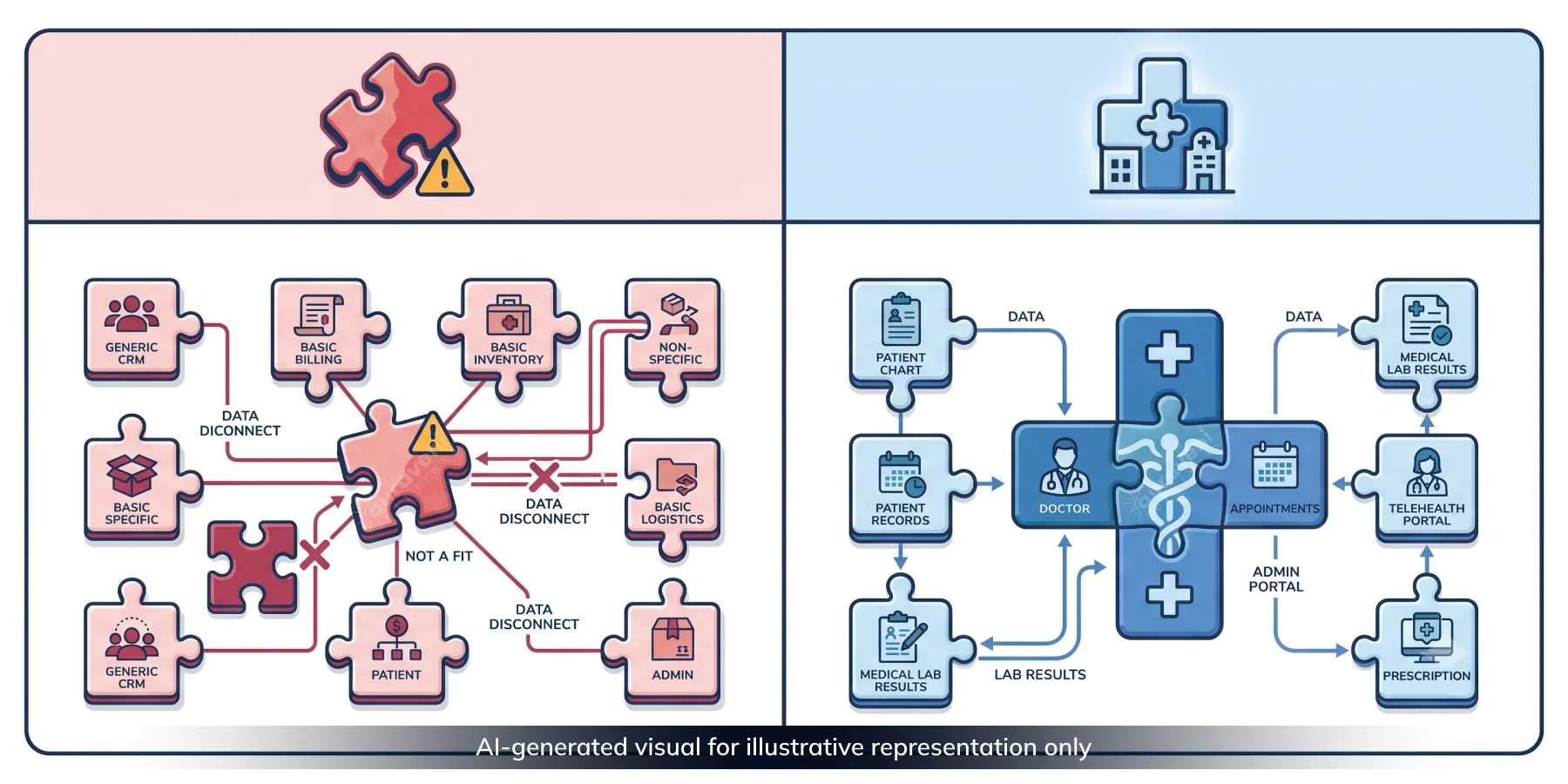
Not every clinic needs a custom build, and we'd rather tell you that honestly than oversell one. A reasonable rule of thumb:
Off-the-shelf likely works if: you're a single-location practice with fewer than 20 staff, your workflows are fairly standard (general practice, dental, basic specialty care), and you don't have specific EHR integration or multi-location reporting needs yet.
Custom development earns its cost if: you're managing multiple locations, you need deep EHR/EMR interoperability that off-the-shelf connectors don't support well, your treatment workflows are complex enough that generic pipelines feel like a constant workaround, or you simply want to own your patient relationship data architecture rather than rent it.
The clinics that try to "add compliance later" onto a generic system almost always discover the same thing: the architectural debt is too deep to fix incrementally, and a clean rebuild ends up cheaper than continuing to patch the original system.
There's also a middle path worth naming honestly, because it's the one most growing clinics actually take: start on a reputable off-the-shelf platform to validate your patient communication workflows quickly, but go in with a deliberate exit plan. That means choosing a platform that lets you export your data cleanly, documenting your actual workflow as it evolves (not just as the vendor's template assumes it should look), and revisiting the build-vs-buy decision explicitly once you cross a second location or a meaningful increase in patient volume — rather than letting the decision get made by default through sheer organisational inertia. The clinics that get hurt are rarely the ones who started with an off-the-shelf tool. They're the ones who never revisited that choice once their needs had clearly outgrown it.
What This Looks Like for a Multi-Location Aesthetic or Specialty Clinic Group
Specialty practices — dermatology, aesthetic medicine, fertility care, multi-location diagnostic chains — tend to hit the limits of generic CRM tooling faster than general practice, because their patient journeys are longer and more structured. A dermatology patient on a six-session treatment plan isn't a single "appointment" in the system; they're a sequence with dependencies, where missing session three changes the timing of every session after it. A fertility clinic's patient journey involves multiple specialists, lab coordination, and emotionally sensitive communication timing that a generic "send reminder 24 hours before appointment" workflow simply wasn't designed to handle with the right tone or cadence.
For these clinic groups specifically, we'd also flag location-level reporting as a feature that's easy to underweight during initial scoping and expensive to retrofit later. Owners managing three or four locations need visibility into which location is converting inquiries into bookings, which referral sources perform best at each site, and where staff follow-up is lagging — broken down by location, not just aggregated across the whole brand. Generic CRMs technically allow this through custom fields and filtered views, but the reporting tends to feel bolted-on rather than native, and staff end up exporting data to spreadsheets to get the view they actually need. A custom-built system can make location-level segmentation a first-class part of every dashboard from day one, which sounds like a small detail until you're the owner trying to figure out why one location's no-show rate is double another's.
How Auraveni Approaches Healthcare CRM Projects
We've built clinic management systems covering multi-location appointment scheduling, e-prescriptions, billing, and telehealth-style consultation workflows — designed around how a real clinic actually operates, not around a generic sales pipeline repurposed for healthcare. Our approach starts with mapping your actual patient journey end-to-end before any database schema gets touched, because the workflow has to drive the architecture, not the reverse.
If you're earlier in the decision process and want a broader view of what separates a CRM project that succeeds from one that becomes another abandoned system, our guide on why your business needs custom CRM software in 2025 covers the general principles that apply across industries before you narrow into healthcare-specific requirements.
Conclusion
A clinic's patient relationships are too operationally important — and, in most jurisdictions, too legally sensitive — to run on software that treats healthcare as an afterthought feature inside a generic sales tool. The clinics scaling smoothly into multiple locations in 2026 are, almost without exception, the ones that invested in a CRM built around their actual clinical and administrative workflow early, rather than discovering its limits during an audit or a growth spurt.
If you're weighing this decision for your own practice, we're happy to walk through your specific workflow and tell you honestly whether custom development is worth it for your stage — not just sell you on the answer that suits us.
FAQs
An EHR (Electronic Health Record) stores clinical data — diagnoses, prescriptions, lab results, and treatment notes — and exists to support clinical decisions and regulatory documentation. A CRM manages the patient relationship layer: communication history, appointment follow-ups, referral tracking, and engagement between visits. They serve different purposes and work best as two integrated systems rather than one trying to do both jobs.
