










From Vibe Coding to Agentic Engineering: What It Means for You
Introduction
In February 2025, Andrej Karpathy — a founding member of OpenAI and former Director of AI at Tesla — coined a phrase that spread faster than almost any technical term in recent memory: "vibe coding." Describe what you want in plain language, let the AI write the code, stay in flow, adjust as needed. It sounded almost too simple to matter. A year later, Karpathy himself was calling the term "passé" — not because the underlying shift had reversed, but because it had already evolved into something more serious and more structured than the freewheeling original description implied.
That evolution is the real story for any business currently evaluating a custom software project. The pace of change in how software actually gets built has been fast enough that pricing assumptions, timeline expectations, and even the question of what makes a development partner good are all shifting under businesses that haven't been paying close attention. This article covers what's genuinely changed, what hasn't, and what it means practically if you're the one commissioning the software rather than writing it.
What "Vibe Coding" Actually Meant, and Why the Term Is Already Fading
The original idea was straightforward: instead of a developer writing code line by line, they describe the desired outcome conversationally, and an AI tool generates working code directly, with the developer reviewing and steering rather than typing every character themselves. It worked well enough for prototypes that it quickly moved into real production workflows at companies like Stripe and Shopify, alongside countless smaller teams.
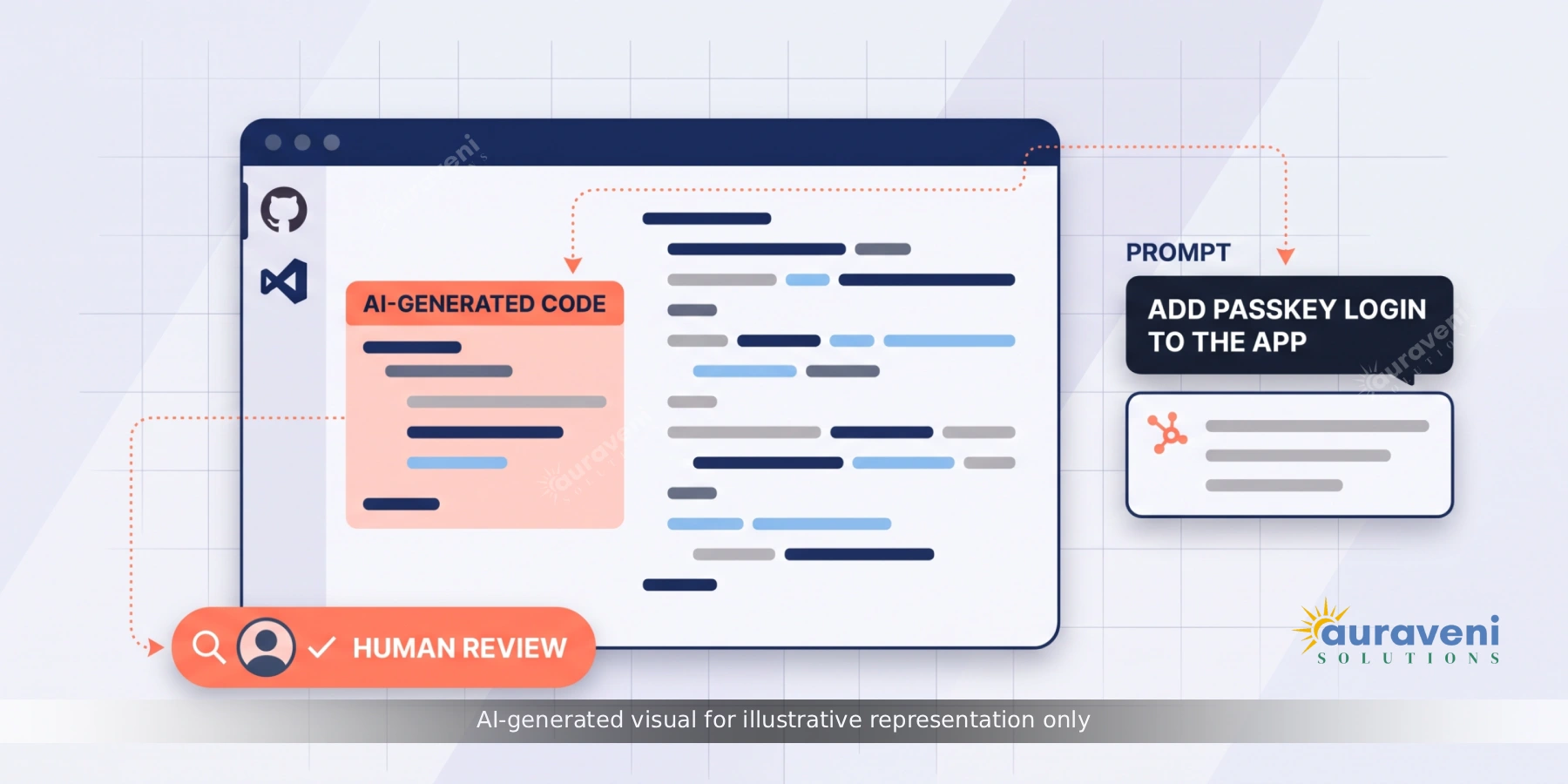
What's superseding the original term is "agentic engineering" — a more structured evolution where AI doesn't just generate a code snippet in response to a prompt, but operates with broader scope: reviewing pull requests, flagging security vulnerabilities before they reach production, writing and running tests, and in some cases opening and managing its own pull requests against a shared codebase, all with defined checkpoints for human review rather than a single prompt-and-accept interaction. The shift in language reflects a real shift in practice — from a personal productivity trick to something closer to a production-grade methodology with its own discipline and guardrails.
The Numbers Behind the Shift
TThe scale of adoption is no longer a niche developer habit. Roughly 92% of US developers report using AI coding tools daily, and by some estimates, around 41% of all newly written code globally is now AI-generated in some form. GitHub Copilot alone counts roughly 20 million cumulative users, with adoption spanning every major development environment rather than a single niche tool.
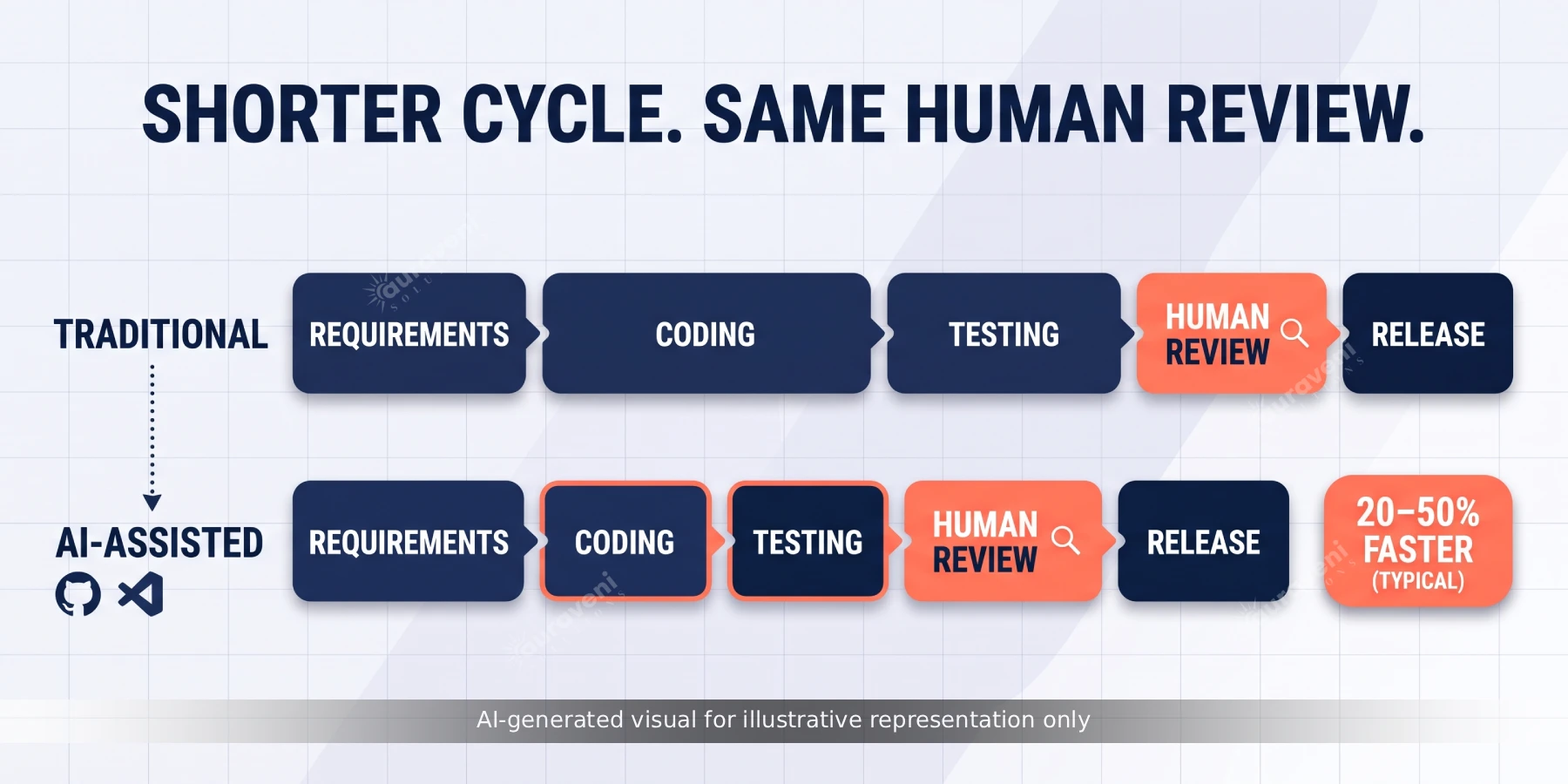
Productivity gains are real, though it's worth being precise rather than breathless about the numbers: early-stage adoption studies commonly cite 20–30% throughput increases, with teams that have gone further into AI-assisted workflows — combining code generation with AI-assisted testing, documentation, and requirement analysis — reporting gains in the 30–50% range. These aren't marketing figures pulled from a single vendor's case study; they show up consistently enough across independent studies to be treated as a reasonable planning baseline, even if any individual team's mileage will vary based on how disciplined their adoption actually is.
What's Genuinely Changed for Businesses Commissioning Software
For a business on the buying side of a custom software project, a few things have shifted in ways worth understanding before a scoping conversation starts. Feature delivery timelines have compressed meaningfully — work that reasonably took weeks in 2023 can, for well-scoped features with a mature team, move from requirement to working, tested implementation in days rather than weeks. Requirement-gathering itself is changing too: AI-assisted analysis tools can now ingest rough source material — meeting transcripts, email threads, existing documentation — and produce structured requirement drafts that flag ambiguities and contradictions between stakeholders before a single line of code gets written, catching the kind of miscommunication that used to surface expensively, mid-build.
And perhaps most practically: pricing benchmarks from even two years ago are genuinely stale. Development teams working with mature AI-assisted workflows are delivering comparable scope with smaller teams and faster timelines, and that efficiency should reasonably be reflected in what a quote looks like today compared to what the same scope would have cost in 2023 or 2024.
What Hasn't Changed (and Why That Matters More Than the Hype)
Here's the part that gets lost in a lot of the breathless coverage of this shift: the early promise — or fear, depending on who you ask — that developers would become obsolete has not materialised, and the professionals actually working in this space describe something considerably more nuanced. The developer's role has changed shape rather than disappeared: part architect, part reviewer, part AI operator, spending less time on repetitive boilerplate and more time on the judgment calls AI still can't reliably make — evaluating tradeoffs between competing technical approaches, understanding a client's actual business context well enough to know when a technically correct answer is still the wrong one, and catching the subtle bugs that a fast, confident AI-generated implementation can introduce without anyone noticing until it's live.
This distinction matters enormously for anyone commissioning software, because "we use AI-assisted development" has become such a universal claim that it's stopped being differentiating on its own. The meaningful question isn't whether a development partner uses AI tools — virtually everyone credible does at this point. It's whether they've integrated AI thoughtfully into a workflow that still has genuine human judgment and architectural discipline at the points that matter, or whether they've mistaken raw speed for quality.
The New Risk: Architectural Drift at AI Speed
This is worth naming directly because it's a genuinely new failure mode rather than an old one restated. Higher development throughput, without the right guardrails, means architectural drift — the gradual accumulation of inconsistent patterns, duplicated logic, and structural shortcuts — can now accumulate considerably faster than it used to, simply because more code is being written and merged per week than before.
We cover this dynamic in more depth in our companion piece on system architecture design and avoiding technical debt, but the short version bears repeating here specifically: a fast AI-assisted team without strong architectural review discipline can produce a system that looks impressively far along in month one and becomes disproportionately harder to maintain by month six, precisely because the pace outran the oversight. The fix isn't slowing down — it's making sure architectural review, not just functional code review, keeps pace with the higher volume of code actually being produced.
Which Tasks Actually Suit AI Generation Right Now
It's worth being concrete about this rather than treating "AI-assisted development" as one undifferentiated capability, because the honest picture is genuinely task-dependent. AI-generated code tends to be reliably strong for well-defined, pattern-heavy work: boilerplate scaffolding, standard CRUD operations, test case generation against an existing specification, converting a design mockup into initial component structure, and documentation drafting from existing code.
It tends to be considerably less reliable, and needs closer human review, for anything involving genuine architectural tradeoffs (should this be a separate service or part of the existing one, and why), business logic with subtle edge cases that aren't obvious from the surface-level requirement, security-sensitive code where a plausible-looking but subtly wrong implementation can pass casual review, and any integration work involving a third-party system's undocumented quirks that only surface through direct experience with that specific provider.
A mature team's AI workflow reflects this distinction explicitly — leaning hard on AI generation for the first category, and treating the second category as requiring the same human-led rigor it always has, regardless of how fast the surrounding codebase is otherwise moving.
What to Actually Ask a Development Partner in 2026
Given how universal AI-tool usage claims have become, the useful questions have shifted. Rather than asking whether a partner uses AI-assisted development, ask specifically where they use it and where they deliberately don't — a thoughtful team should have a clear, considered answer distinguishing tasks well-suited to AI generation from ones that still get built and reviewed primarily by a human. Ask how architectural review is handled at their current development pace, since this is precisely where an undisciplined team's process breaks down first. And ask how their pricing reflects the efficiency gains they're claiming — if a partner says AI has meaningfully sped up their delivery, that claim should show up somewhere in how they scope and price work, not just in their marketing copy.
Pricing Benchmarks Are Shifting Too
Following directly from the above: if you're evaluating quotes against what similar scope cost in 2023 or 2024, it's worth recalibrating that expectation. A mature, AI-integrated development team delivering comparable functionality with a smaller team and faster timeline should reasonably reflect that efficiency in what they charge, not simply pocket the entire productivity gain while quoting at old-benchmark rates. This doesn't mean every quote should be dramatically lower — architecture, judgment, and the unglamorous integration and testing work haven't gotten cheaper — but the raw code-production component of a project's cost structure has shifted meaningfully enough that it's a fair, reasonable question to raise directly in a scoping conversation.
How Auraveni Uses AI in Our Own Development Process
We use AI-assisted development tools across our own engineering workflow — for boilerplate generation, test writing, and accelerating routine implementation work — while keeping architecture decisions, business logic design, and code review firmly in human hands, for exactly the reasons covered above. If you're weighing a web application build or scoping a broader project and want a straight answer about where AI genuinely speeds up delivery for your specific requirements versus where it doesn't, that's a conversation we're glad to have directly rather than defaulting to a marketing answer.
Conclusion
The shift from vibe coding to agentic engineering in barely a year says something important about how fast this space is moving — but the headline productivity numbers only tell half the story. What actually matters for a business commissioning custom software isn't whether a partner uses AI tools; virtually all credible ones do. It's whether they've kept genuine architectural discipline and human judgment in place at the speed AI now enables, or let raw throughput outrun the oversight that prevents a fast start from becoming an expensive mess by month six. Ask the right questions, and the pricing and timeline conversation should look meaningfully different from what it would have two years ago.
If you're scoping a project and want an honest read on realistic timelines and pricing in this new landscape, we're happy to walk through it.
