















Passwordless Authentication: Why Passkeys Matter Now
Introduction
For years, "this will be the year passwordless finally happens" was close to an industry joke — predicted annually, delivered rarely. The 2026 data suggests it may have actually happened this time: the FIDO Alliance now estimates 5 billion passkeys in active use worldwide, consumer awareness has climbed to 90%, and three in four people have enabled a passkey on at least one account.
That's a genuinely different picture from even two years ago. But adoption arriving doesn't mean the transition is complete, and for a business deciding whether and how to implement passkeys into its own web or mobile application, the honest picture is more nuanced than the headline numbers suggest. This article covers what's actually happening, what it means practically, and where passkey implementation earns priority over other engineering work competing for the same sprint.
What a Passkey Actually Is (and Why It's Fundamentally Different)
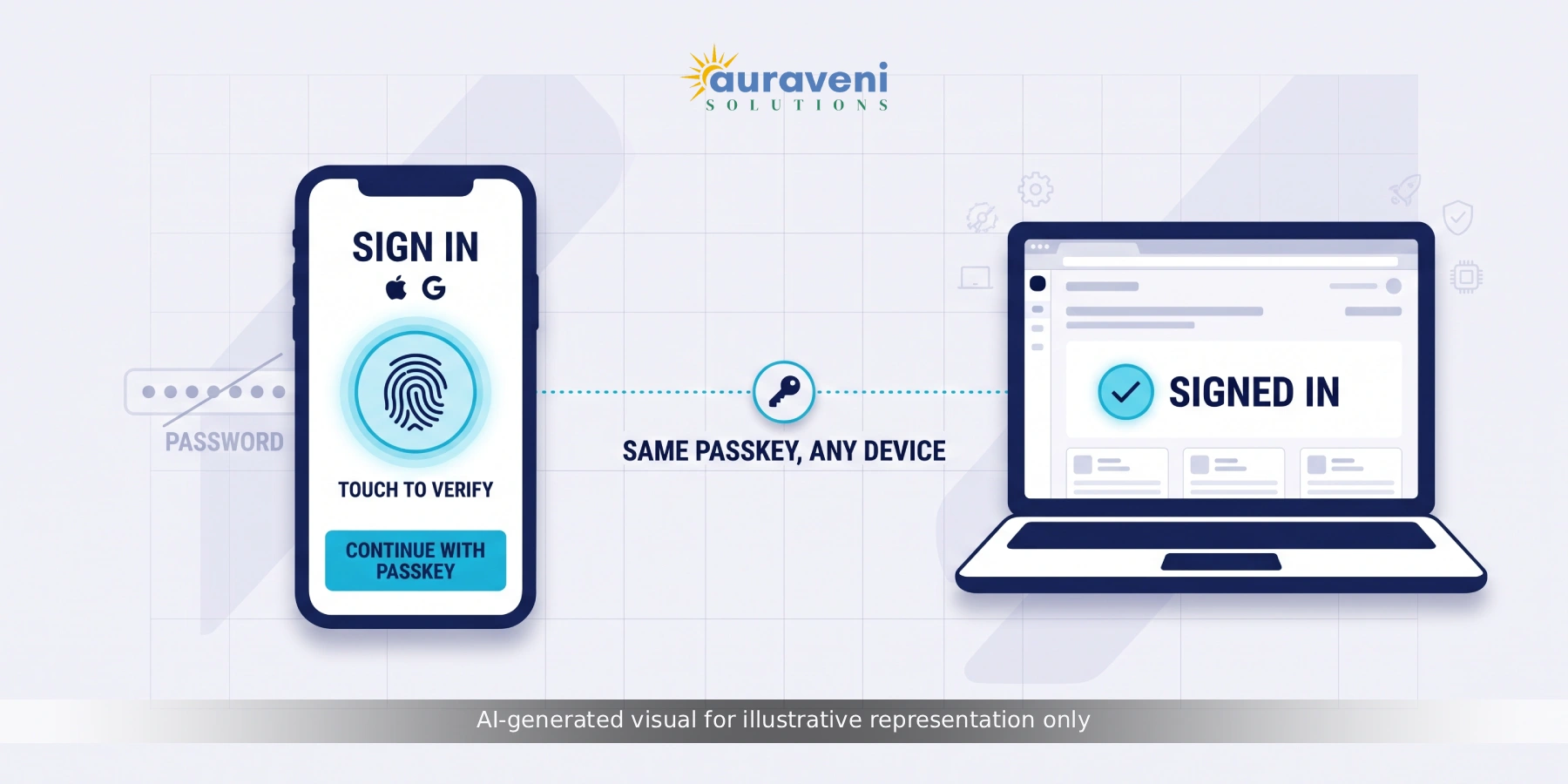
A passkey isn't a longer, more complicated password — it's a fundamentally different authentication mechanism built on public-key cryptography (the FIDO2/WebAuthn standard). Instead of a shared secret the user types and the server stores, a passkey generates a cryptographic key pair: a private key that never leaves the user's device, and a public key the server holds, which is useless to an attacker on its own since it can't be used to log in without the matching private key.
The practical consequence is that passkeys are structurally resistant to the attacks that make passwords such a persistent problem — phishing (there's no secret to trick someone into typing), credential stuffing (there's no reusable secret to steal from one breached site and try on another), and brute-force guessing (there's no password to guess). The login itself typically happens through a device's existing biometric unlock — a fingerprint or face scan — or a device PIN, which the user was almost certainly already using to unlock their phone anyway.
The 2026 Adoption Numbers
The FIDO Alliance's most recent State of Passkeys report, based on research spanning eleven thousand consumers and fourteen hundred enterprise decision-makers across ten countries, paints a picture of genuine mainstream arrival on the consumer side: 90% awareness, 75% having enabled a passkey somewhere, and 49% using one regularly when it's offered as an option.
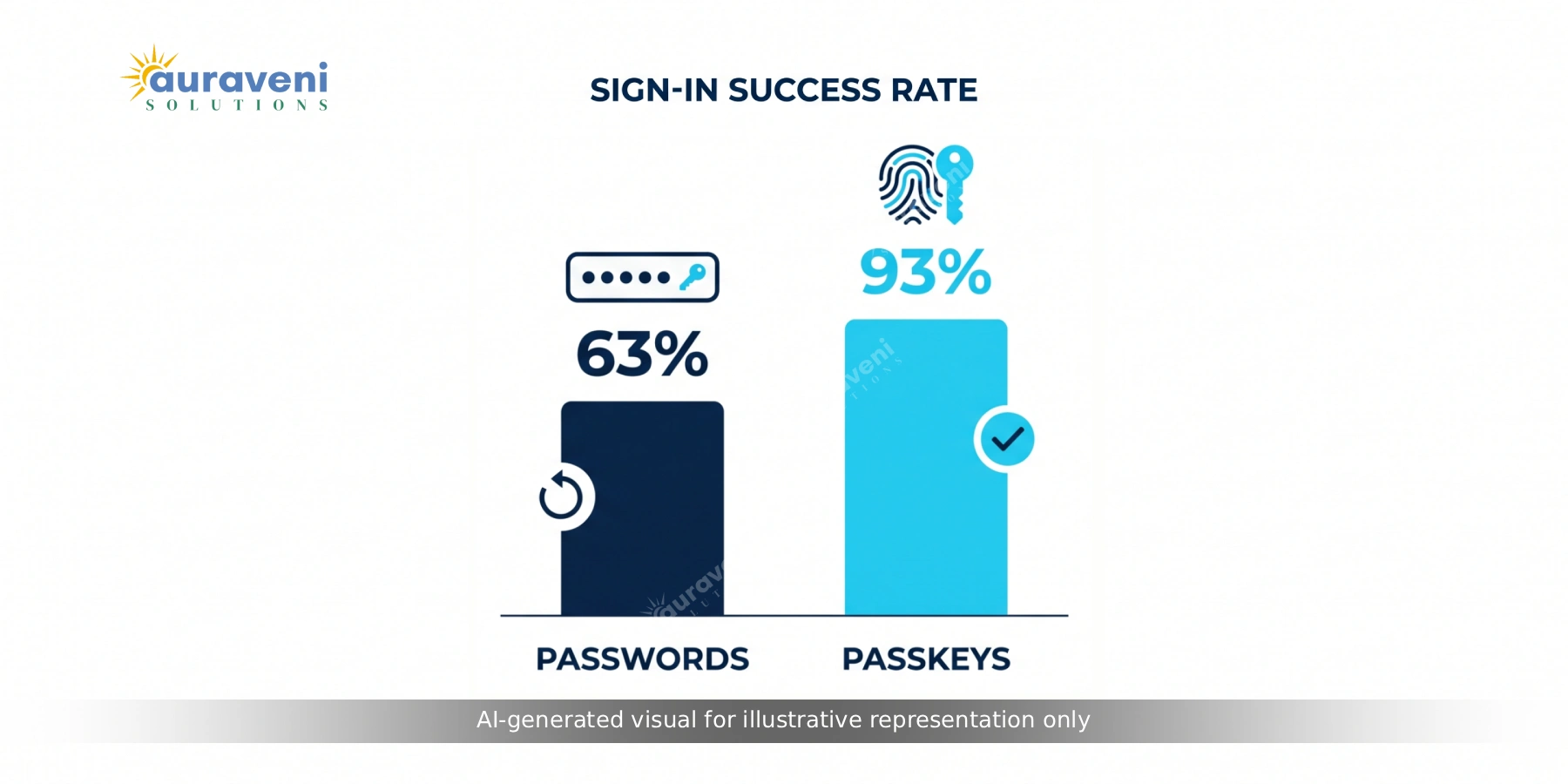
On the login performance metrics businesses actually care about, passkeys are outperforming passwords clearly — a roughly 93% login success rate compared to 63% for traditional password entry, largely because there's nothing to mistype, forget, or need to reset. Enterprise-side, 68% of organisations report deploying, piloting, or actively rolling out passkeys for employee authentication, and 82% name full passwordless authentication as an eventual workforce goal, though only 28% say they've actually reached it.
That gap between stated goal and achieved reality is worth sitting with, because it points to the honest state of things: 57% of organisations still rely on a phishable method as their primary sign-in approach even now. Adoption has clearly arrived. The full transition hasn't.
Why Fintech Is Leading and Media Is Lagging
Passkey adoption isn't uniform across industries, and the pattern is genuinely instructive. Fintech leads by a wide margin, at roughly 60% adoption, which makes sense once you look at the economics: a single account takeover in financial services typically costs somewhere between $200 and $4,500 in direct fraud losses and remediation, which makes the business case for aggressively prompting users toward passkeys close to a formality. Layer in regulators across the EU, UK, Singapore, and increasingly the US writing strong customer authentication requirements into law, and security, product, and compliance teams all land on the same priority for once.
eCommerce sits around 35% adoption — meaningful, but with real room to grow, particularly given how directly checkout friction and cart abandonment tie to login experience. SaaS trails at roughly 28%, and media sits lowest at around 18%, generally reflecting how much lower the direct cost of a compromised account is in those categories compared to a compromised bank or trading account.
The Business Case Beyond Security
Security is the headline reason, but it's not the only one, and for a lot of businesses it may not even be the most persuasive one. The conversion and retention argument is genuinely strong on its own: password resets are a well-documented source of checkout and signup abandonment, and a 93% versus 63% login success rate translates directly into fewer frustrated users giving up mid-login and fewer support tickets tied to "forgot password" flows, which are consistently among the highest-volume support categories for any consumer-facing product.
There's also a cost-reduction angle that's easy to underweight: SMS-based one-time-password verification, still common as a fallback authentication method across Indian and other markets, carries a real per-message cost at scale. Deployments that successfully shift a meaningful share of logins to passkeys report measurable reductions in both support ticket volume and SMS OTP costs as a direct consequence.
What "Adoption" Actually Means: A Necessary Caveat
Here's a distinction worth being genuinely careful about, because it's where a lot of adoption statistics get misleading: there's a meaningful gap between "a user has saved a passkey" and "a user actively authenticated with it in the last 30 days" — industry analysis puts that gap at roughly 12 to 18 percentage points. A business proudly reporting "45% passkey adoption" is very often describing the saved figure, not the actively-used one, and the two numbers tell genuinely different stories about how deeply the technology has actually taken hold.
This matters practically because it should shape how a business measures its own rollout. Tracking active use over a rolling window, not just enrollment, gives a far more honest picture of whether a passkey implementation is actually reducing password-related friction and risk, or just sitting unused as an option nobody's actually taking.
Cross-Device Sync and the Account Recovery Problem
One technical nuance worth understanding before implementation starts: modern passkey standards support cross-device syncing through platform credential managers — Apple's iCloud Keychain, Google Password Manager, and similar services from Microsoft and major password managers — meaning a passkey created on a phone can generally also work when signing in from a laptop, provided both devices are signed into the same platform ecosystem. This addresses what was, in earlier passkey implementations, a genuine usability gap.
Cross-ecosystem scenarios are where things get more complex. A user who creates a passkey on an Android phone and later tries to sign in from a Windows laptop using a different browser ecosystem needs a fallback mechanism — commonly a QR-code-based cross-device authentication flow, where the laptop displays a code the phone scans to complete the login using its locally stored passkey. This works well when implemented properly, but it's a meaningfully more complex flow than a simple password field, and it needs real user testing rather than an assumption that it'll behave the same way a demo did.
Account recovery deserves equally deliberate design. Losing the device holding a passkey is a fundamentally different recovery scenario than a forgotten password, since there's no "reset link sent to your email" equivalent that makes sense in the same way. A well-designed recovery flow typically combines a secondary registered passkey on a different device, a traditional identity-verification fallback for genuine lockout scenarios, and clear user education at signup time about registering a backup method — a detail that's easy to skip during initial implementation and expensive to explain to a locked-out user afterward.
What Implementing Passkeys Properly Requires
Technically, passkey support isn't a small feature toggle — it requires WebAuthn-compliant implementation on both the client and server side, a coherent fallback strategy for users on devices or browsers that don't support passkeys yet, and careful handling of account recovery, since losing access to the device holding a passkey is a genuinely different recovery problem than a forgotten password reset email.
This is also, candidly, an area where a lot of teams are under-resourced relative to the expectation placed on them: industry surveys find that roughly half of organisations are relying on developers with limited authentication-specific experience to build customer-facing identity systems, and fewer than a third have dedicated identity and access management engineers on staff. Authentication is one of those systems where a subtly wrong implementation doesn't fail loudly — it fails quietly, as a security gap nobody notices until it's exploited, which makes it a poor candidate for a rushed, first-time implementation without proper review.
Where to Prioritise First
Not every product needs passkeys as the very next sprint, and it's worth being honest about sequencing rather than treating this as universally urgent. The clearest priority cases: any product handling financial transactions or sensitive personal data, where account takeover cost is highest and regulatory pressure is real; any product with high password-reset support volume, where the UX and cost case is immediate and easy to measure; and any mobile app already using biometric unlock for other purposes, since the user experience shift is minimal — they're already comfortable with the exact same fingerprint or face-scan interaction.
Lower-priority cases — a low-stakes internal tool, a product with infrequent login patterns — can reasonably wait, provided the fallback authentication in the meantime is still reasonably strong. The point isn't universal urgency; it's matching the investment to where the security and conversion case is actually strongest for a given product.
How Auraveni Approaches Authentication Architecture
We treat authentication as a first-class architecture decision, not a checkbox feature bolted on late — a principle we cover more broadly in our guide to system architecture design and avoiding technical debt, since authentication is exactly the kind of foundational decision that's cheap to get right early and genuinely painful to retrofit later. For businesses building or rebuilding a web application or mobile app, we scope passkey support alongside a sensible fallback strategy and proper account recovery flows from the start, rather than treating it as an isolated feature request disconnected from the rest of theauthentication system.
Conclusion
Passwordless authentication has moved from a prediction to a measurable reality faster than most of the industry expected, but the gap between "passkeys exist as an option" and "a business has actually completed the transition" is still wide — even among organisations that say it's a stated goal. For a business evaluating this now, the practical question isn't whether passkeys matter; the data on login success rates and fraud reduction settles that. It's where to prioritise the implementation first, and whether the team building it actually has the authentication-specific expertise to get a genuinely security-sensitive system right the first time.
If you're weighing where passkey support fits into your product roadmap, we're glad to help you think through the priority and the implementation together.
